
Trouble concentrating is one of the most common reasons people start wondering about ADHD. You lose your place mid-paragraph, leave tasks half-finished, forget the thing you walked into the room for. Or a parent notices that homework takes three times as long as it should, and that their child seems to drift off whenever the work gets hard.
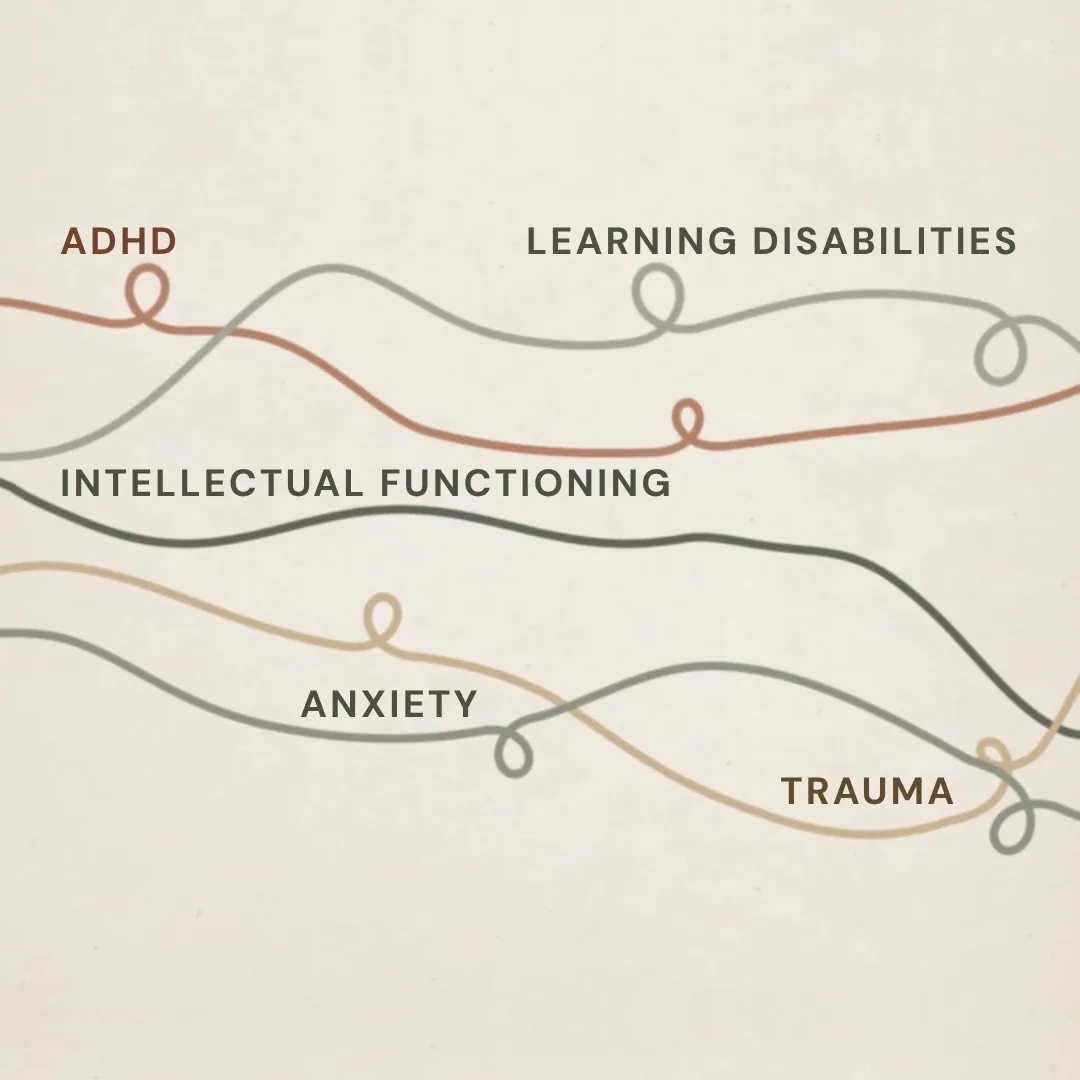
Sometimes the answer is ADHD. Often it is something else, and fairly often it is more than one thing at once. Inattention is a symptom, not a diagnosis, and telling the possibilities apart is the whole point of a careful evaluation. Here is how we think about that question, including when a full evaluation is worth it and when it is not.
Why do so many conditions look like ADHD?
Attention, concentration, motivation, organization and short-term memory all draw on the same mental machinery, the set of skills psychologists call executive functioning. Those skills are sensitive. Worry, low mood, poor sleep, stress and a task that is genuinely too hard can all wear them down, and the result looks much the same from the outside: distraction, procrastination, unfinished work, forgotten details.
That is why a list of symptoms on its own cannot settle the question. Two people can describe exactly the same difficulties for completely different reasons. The diagnostic criteria for ADHD reflect this. They ask not only whether the symptoms are present, but whether they began in childhood, whether they show up across more than one setting, whether they cause real problems in daily life, and whether something else explains them better.
How can anxiety, depression, trauma, sleep and learning difficulties affect attention?
A few everyday examples show how differently the same complaint can arise.
- Anxiety. A student reads the same page four times, not because their mind wanders to something more interesting, but because part of it is busy rehearsing what could go wrong. Worry takes up the mental space that concentration needs.
- Depression. Thinking can feel slow and effortful, starting a task can feel heavy, and things that used to hold someone’s interest no longer do. From the outside it can look like a focus problem.
- Trauma. Someone who is constantly scanning for danger has less attention left for anything else, and may also zone out under stress. In children this can look a great deal like inattention or restlessness.
- Sleep. Too little sleep, or poor-quality sleep from an unrecognized sleep disorder, reliably impairs concentration, patience and memory. Tired children are often more restless rather than visibly sleepy.
- Learning difficulties. A child with an undiagnosed reading disorder may seem inattentive only during reading, because decoding every word is exhausting. Give them a story read aloud and their attention may be fine.
Some medical conditions and medications can affect concentration too, which is one reason a physician’s input can be part of the picture.
These examples are not a checklist for self-diagnosis. Most people recognize a little of themselves in several of them, and that is exactly the point: the overlap is real, and sorting it out takes more than a description of the symptoms.
Can someone have ADHD and anxiety at the same time?
Yes, and it is common. ADHD frequently occurs alongside anxiety, depression, learning disorders and sleep difficulties. Sometimes one grows out of the other: years of missed deadlines and frequent criticism can leave a person with ADHD anxious about falling short. Sometimes they are simply separate conditions that happen to arrive together.
This matters because assuming there must be a single explanation can lead to treatment that only half works. If attention is treated while anxiety is left alone, or anxiety is treated while an underlying learning disorder goes unnoticed, people often feel somewhat better without feeling well. A good evaluation asks not “which one is it?” but “what is contributing, and how much?”
What makes psychological assessment different from an online ADHD quiz?
Online quizzes are symptom checklists. They can be a reasonable prompt for a conversation, but they count behaviors without asking why they happen, and they cannot weigh one explanation against another. Many people with anxiety, depression or poor sleep score highly on them.
A psychological assessment brings several kinds of information together:
- A clinical interview about current difficulties, and what has and has not helped
- Developmental history, because ADHD begins in childhood; school records and early report cards can be revealing
- Information from more than one source, such as a parent, teacher or partner, since attention problems often look different at home, at school and at work
- Standardized measures, compared against large groups of people the same age, chosen to fit the question being asked
- Careful screening for other explanations, including mood, anxiety, trauma, sleep and learning
No single test can diagnose ADHD. The value of an assessment lies in the interpretation: reconciling everything into an explanation that fits.
When is a comprehensive evaluation worthwhile, and when might it be unnecessary?
Not everyone with attention difficulties needs comprehensive psychological testing. When the history is clear, the difficulties have been present since childhood across settings, and other explanations have been reasonably considered, a careful clinical evaluation by a psychiatrist, psychologist, pediatrician or primary care clinician can often answer the question without an extensive battery of tests.
A comprehensive evaluation is more likely to be worthwhile when:
- Several explanations are plausible at once, such as attention alongside anxiety, mood, trauma or sleep concerns
- There are academic difficulties that might reflect a learning disorder
- Previous treatment has not helped the way it was expected to
- Earlier opinions have conflicted, or a diagnosis has never quite fit
- An adult is seeking a first diagnosis and the history is complicated
- A school, college or testing organization requires detailed documentation
- You want a detailed picture of strengths and weaknesses to plan around
If you are not sure which situation you are in, that is a reasonable thing to talk through before committing to anything.
What happens after testing?
A good evaluation ends with a conversation, not just a score. You should receive a written report and a feedback session that explain what was found, whether a diagnosis is supported, and, just as usefully, what was ruled out.
The recommendations are where the work pays off. Depending on the findings, they might include therapy for anxiety or mood, a conversation with a prescriber about ADHD treatment, an evaluation of sleep, tutoring or specific instructional approaches, and practical strategies for home, school or work. Where appropriate, the report can support requests for academic or workplace accommodations, although those decisions belong to the school, employer or testing organization.
Most of all, an evaluation should leave you with a clearer explanation than the one you came in with, and a sense of what to do next.
Wondering about your own attention, or your child’s?
At Haven, psychological evaluations are conducted in person in Wesley Chapel by Dr. Nikel Rogers-Wood, for ages 8 through 64. If you are unsure whether testing is the right step, a free 15-minute consultation is a good place to start. If something other than an evaluation would serve you better, we will say so.
- ADHD evaluations explains what an ADHD evaluation at Haven looks at.
- Diagnostic clarification covers evaluations for overlapping concerns and conflicting diagnoses.
- Psychological testing and evaluation describes the full assessment service and how the process works.